Drag a piece or tap its starting and destination squares.
BEFORE THE MOVE
How would you bring the rook into the attack?
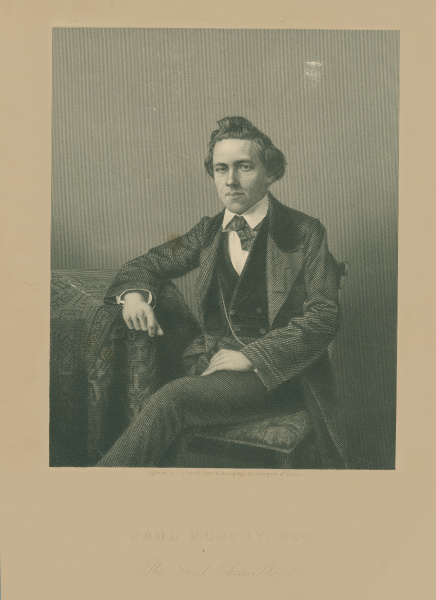
Morphy has White against the Duke of Brunswick and Count Isouard. Black has more material, but its king is still in the centre. You arrive just before move 16.
WHAT HAPPENED
16. Qb8+ gives up the queen to deflect the knight from d7, which blocks the d-file. After …Nxb8, 17. Rd8 is mate: the bishop on g5 protects the rook and cuts off e7.
Attack / checkProtectionPlan
Video and complete game ↗Another historic decision →Keyboard: arrow keys between squares; Enter to select.
FOR THE TEACHER
The lesson, step by step.
01Meet the story3 min
Introduce Morphy and locate Paris in 1858. Ask what has changed since that era.
02Read the board5 min
Project the position without its solution. In pairs, locate the black king and the white pieces that can attack it.
03Find your move7 min
Each pair proposes a move and explains its idea. Try it on the board; then reveal Morphy’s decision.
04Explain the idea5 min
Follow the three half-moves. Draw which piece protects the rook and explain why it is mate.
Before you start
Moving the pieces; recognising check and checkmate.
A projector or chessboard, paper and pencils. One worksheet per pair.
Recognise how a rook and bishop work together to deliver mate.
To close the lesson
What matters more here: an extra piece or a rook entering with check?
If there is time
Return to the earlier position: what stopped the rook from entering d8 directly?
Explore the sources
Portrait credits
- Paul Morphy (c. 1859) — D. J. Pound · Cleveland Public Library / DPLA. Original · Public domain

Original files are preserved; framing and a paper tint are applied on screen. Displayed versions retain each portrait’s license.